
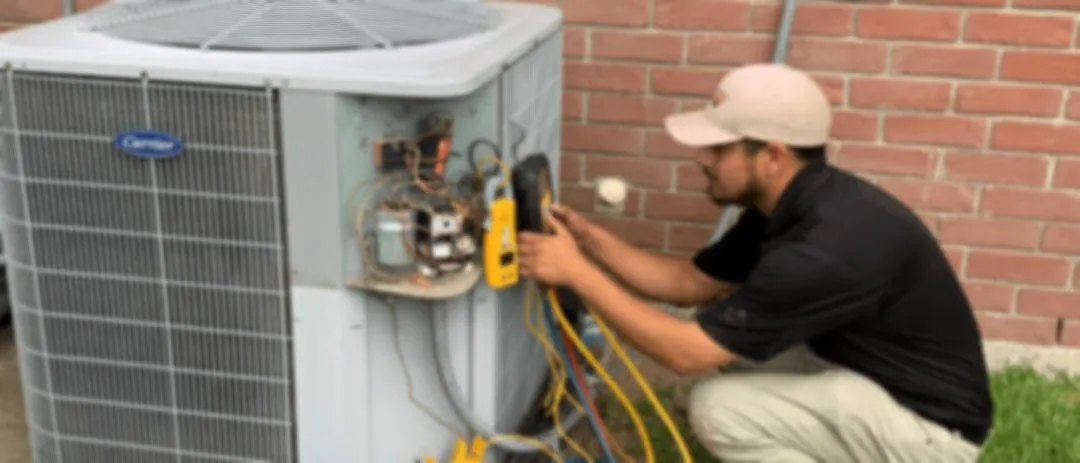
AC humming with a motionless outdoor fan is a reason to stop and arrange help.
Do not reach through the grille or try to push the blades into motion at your Katy home.
The sound may suggest that part of the equipment is trying to operate, but it does not identify the failed component.
Your task is to describe the combination of sound, fan movement, and indoor cooling.
What this combination can mean
A new hum with an outdoor fan that will not spin can involve the motor, its electrical support components, or a control problem.
Turn cooling off using the normal control if safe, keep clear of the unit, and arrange professional diagnosis.
Do not try to start the blades manually.
Carrier explains motor and capacitor problems in its AC fan troubleshooting guide.
It warns that capacitors can retain a dangerous charge after power is off.
A capacitor is an electrical component, not a homeowner inspection point.
You do not need to locate it to report the symptom.
Leave the service panel attached, even if an online video makes removal look simple.
Also avoid assuming that every moment of stillness signals failure.
What matters here is a new hum, a failed cooling request, and a fan that does not behave as expected for your equipment.
Observe from outside the equipment
Use a safe viewing position with clear footing. Look through the existing grille without touching it.
Do not lean over the unit to listen more closely or place your phone inside the guard.
If you can safely capture a brief recording, include the sound and the fan in the same frame.
Stop recording if the sound becomes louder or anything appears unsafe.
A video is optional, not a condition for requesting service.
- Does the sound begin when the thermostat requests cooling?
- Is the outdoor fan still, turning slowly, or starting and stopping?
- Does indoor air continue moving through the vents?
- Is the room getting warmer despite the cooling request?
- Did the symptom begin after an outage or yard work?
Keep the wording literal.
“Low hum, fan still, room warming” is more useful than deciding that the motor or compressor is ruined.
Several problems can produce overlapping symptoms.
If you have already shut cooling off, do not restart it just to answer every question.
Report what you noticed before shutdown and leave the remaining details for the technician.
Never use a stick to start the fan
A stopped fan may restart without warning.
Inserting a stick, screwdriver, or hand through a guard brings you close to moving parts and energized equipment.
It also turns an observation into an unsafe repair attempt.
Do not remove the top grille or fan assembly.
A thermostat set to off does not make internal components safe to handle.
Avoid touching wires, terminals, or any part behind the access cover.
If a branch appears caught in the blades, leave it in place and describe it.
Do not pull material through the grille while trying to hold the fan still.
Photograph the obstruction only from outside the unit.
For this symptom in Katy, Katy Plumbing's AC repair service can assess the equipment.
Mention that the outdoor fan is not turning while the unit hums.
Distinguish outdoor silence from indoor airflow
Your indoor fan and outdoor fan are different parts.
Air moving from a ceiling vent does not prove that the outdoor equipment is functioning.
Likewise, a quiet indoor room does not reveal which outdoor component is active.
Trane's fan troubleshooting guidance discusses several possible conditions, including thermostat settings and power issues.
A complete diagnosis uses more than the sound you hear.
Check the thermostat display from inside. Note cooling mode, room temperature, and any alert.
If the display is blank, include that detail.
Do not open its base or connect wires to see whether the fan starts.
In a home with two outdoor units, identify which one made the sound.
You can describe its position, such as the unit nearest the gate.
Do not assume a label matches a room unless you know that connection.
Keep the equipment off when warning signs appear
A burning smell, smoke, or damaged wiring ends the observation. Stay clear and seek urgent help.
For fire or immediate danger, leave the area and call emergency services from safety.
If the unit repeatedly tries to start, do not let it continue as a diagnostic experiment.
Use the normal control to stop cooling if safe, then explain the repeated attempts when you call.
Do not reset a tripped breaker again and again.
If someone already reset it, record whether it held or tripped again. That history is a clue worth preserving.
Keep pets and children away from the outdoor equipment while awaiting service.
Do not stack objects around the unit to reduce the sound or cover it with a blanket.
Leave a clear approach for inspection.
If the hum stopped before you reached the thermostat, record that too.
An intermittent sound may not be present when help arrives.
Include whether cooling returned afterward, but do not intentionally repeat the event.
A short history of two separate episodes can be more useful than a long recording made while the equipment struggles to run.
Keep the original recording at normal speed. Slowing or filtering the audio can change how the sound is perceived.
Ask for an explanation tied to the findings
During the service conversation, ask which test explains the humming and still fan.
If a component needs attention, ask how its condition was established.
You should not need to accept a diagnosis based only on the word “hum.”
Share any earlier episodes, even if the fan later started by itself. An intermittent symptom still matters.
A date and short description can help connect separate events without exaggerating how often they happen.
After work is complete, ask what startup behavior is normal for the equipment.
Note whether there are settings that affect fan behavior. Keep that explanation with your household equipment records.
For AC humming with a still outdoor fan in Katy, contact Katy Plumbing.
Report the sound, fan behavior, thermostat message, and whether you have stopped cooling.