
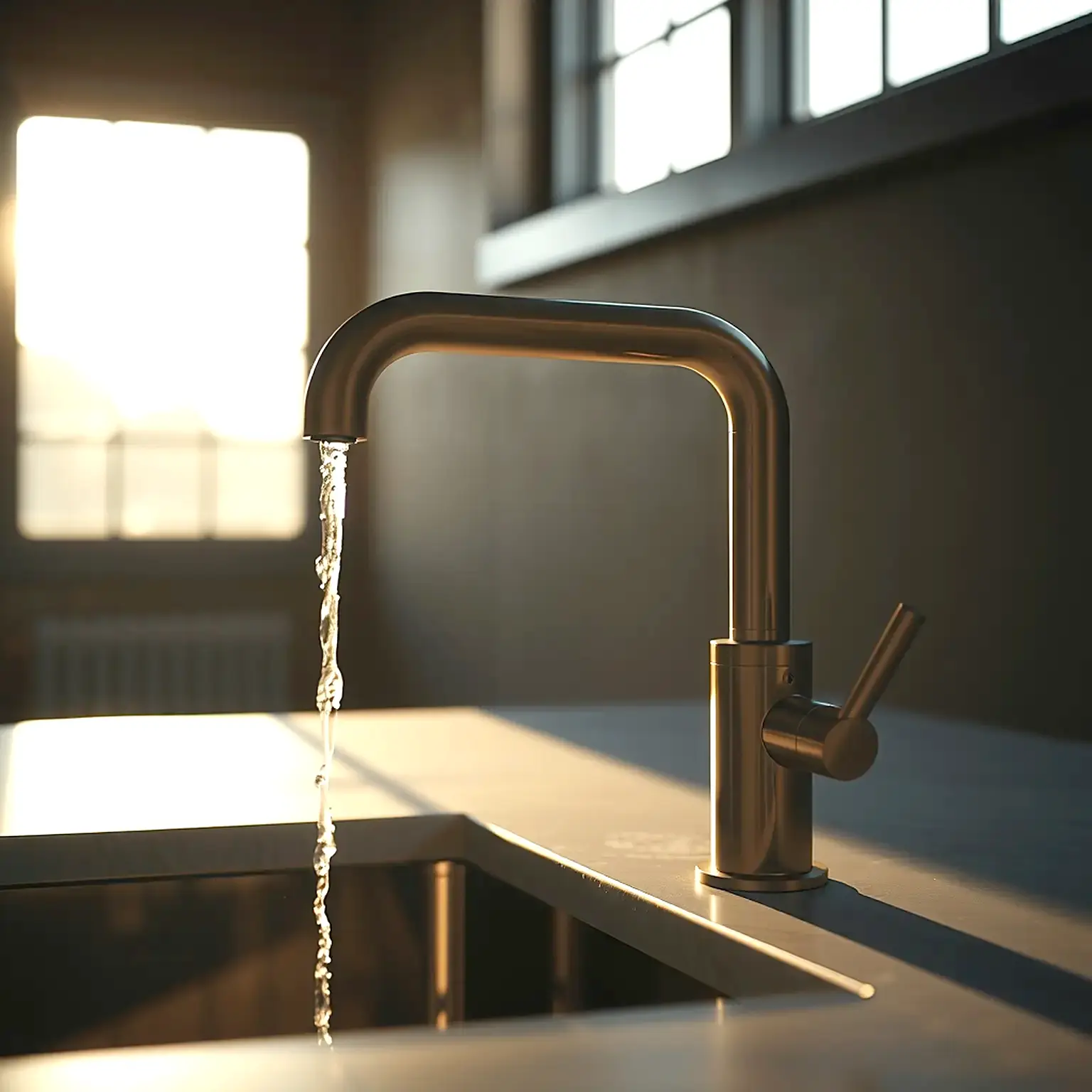
Low faucet flow is frustrating when one sink barely rinses your hands while another works normally.
That difference is useful: it gives the check a more focused starting point than assuming the whole home has lost water pressure.
For a Katy homeowner, the safest first step is a short check using normal faucet controls.
You can record what has changed without opening supply lines, removing parts inside the faucet, or turning unfamiliar valves.
Compare the same conditions
When low faucet flow affects one sink, compare that faucet's hot and cold settings and note whether a nearby faucet behaves normally.
Record a change from the fixture's usual flow.
A weak stream is something you can see, not a pressure measurement. It does not reveal the exact restriction.
Use the normal controls only, and avoid putting your hands under hot water while comparing.
If the sink drains slowly or water is leaking into the cabinet, stop the check and report that problem too.
A different faucet may be designed to deliver a different stream.
The most useful check is how each fixture behaves now compared with its own normal flow.
A kitchen spray head and a bathroom spout are not identical benchmarks.
Separate hot-only, cold-only, and both
A short note can organize the symptom before you call. Do not keep running water to get a perfect result.
A brief check during normal use is enough.
- Both settings weak: note whether the stream is thin, uneven, or spraying sideways.
- Only hot weak: say whether cold flow still appears normal at that sink.
- Only cold weak: describe the difference without reaching beneath the fixture.
- Another sink also changed: name the room and when the change began.
- Only one spray mode weak: record which normal setting behaves differently.
For a single-handle faucet, mixed settings may make the difference less obvious.
Report uncertainty instead of claiming the hot or cold side is definitely responsible.
If a recent service visit changed a valve position, mention the visit.
Do not force the valves beneath the sink to see whether that restores the stream.
Why a local restriction is one possibility
Moen's low-flow guidance names debris in an aerator or cartridge, a stuck diverter, and a malfunctioning spray wand as possible causes that depend on the model.
It also emphasizes finding the faucet model before selecting a repair.
An aerator is the small outlet part that shapes the stream. A cartridge is a control part inside the faucet.
A diverter directs water between outlets on fixtures that use one.
These parts have different jobs and are not the same.
The symptom does not tell you which part to replace.
A plumber may need to compare the supply reaching the fixture with the water leaving it.
That work goes beyond looking at the stream.
Do not treat a stronger stream from another room as proof that every upstream component is sound.
It simply helps define the current pattern.
Keep simple cleaning within the model instructions
If your faucet manual identifies a removable aerator and gives a user cleaning method, follow that specific guidance.
Some outlets need a special tool or contain small components that must stay in order.
Do not grip a finished spout with bare pliers or pry at an insert you cannot identify.
Stop if the part resists.
A damaged outlet can add a new problem while the original low faucet flow remains.
Moen's aerator guidance notes that aerator designs and installation methods vary.
That is why a generic removal direction may not fit your faucet.
Do not remove, drill, or permanently alter a flow-control part to make the stream stronger.
Ask for the correct maintenance method and an assessment of the actual change in flow.
Record what happened before the change
The recent history can help without becoming a diagnosis.
Think about the last time the faucet worked normally and the first time you noticed the weaker stream.
Useful events to mention include a water service interruption, nearby plumbing work, a new faucet, or a change to the spray head.
If nothing happened, say that too.
For example, a kitchen faucet that changed after a service interruption presents a different history from one that slowly weakened over months.
Neither timeline proves the cause, but both belong in the service notes.
Katy Plumbing's faucet and fixture service can inspect an ongoing problem.
Provide the model if known and describe whether hot, cold, or both settings are affected.
Do not confuse a weak stream with a hidden leak diagnosis
Low faucet flow alone does not prove that water is escaping inside a wall or beneath the home.
Avoid choosing a major repair based only on the look of one outlet.
However, a wet cabinet, fresh wall stain, or sound of running water when fixtures are unused is separate evidence worth reporting.
Do not ignore those details simply because the weak stream seems minor.
If you find active leakage, stop using the fixture and keep clear of water near electrical equipment.
You can describe the flow problem later, after the immediate leak is addressed.
For a Katy home with multiple affected fixtures, tell the plumber the broader pattern.
The investigation should reflect all the symptoms rather than remain fixed on the first sink you noticed.
Confirm the result during normal use
After service, ask what caused the restriction and what normal use should look like for the fixture.
If an outlet component was cleaned or replaced, keep the model information for future maintenance.
Use the same ordinary controls you used before the visit.
Note whether the original symptom is gone and whether the cabinet remains dry.
Do not compare the result with a different fixture with a stronger stream and assume it is still wrong.
Keep spray hoses clear of stored items that could interfere with their normal movement.
Leave valves accessible so future service does not require clearing a packed cabinet first.
For ongoing low faucet flow at one sink in Katy, contact Katy Plumbing.
A focused description helps the check begin at the right fixture.