
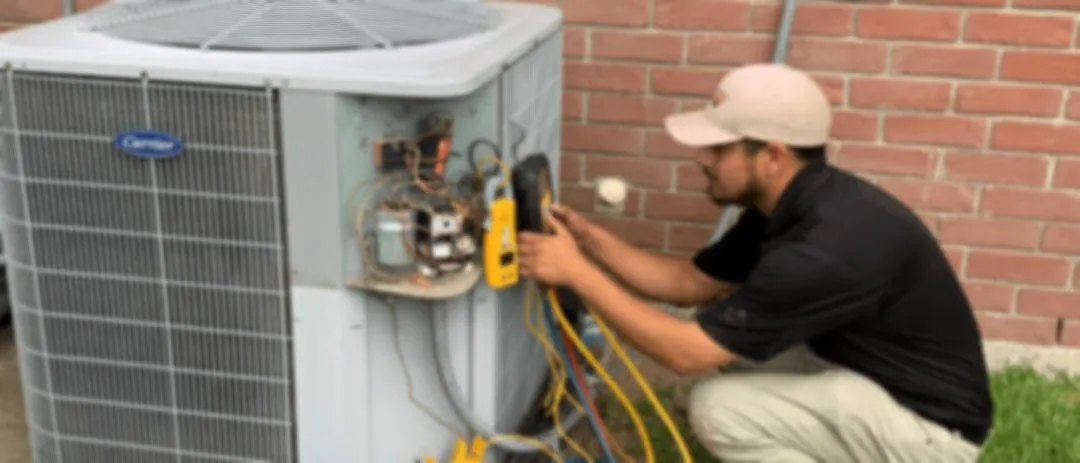
AC short cycling can make your Katy home feel warm even while the equipment keeps starting.
The most useful first step is to record what stops, what keeps running, and whether the room reaches its set temperature.
A repeated start and stop is a symptom, not a diagnosis.
This guide helps you collect clear clues without opening equipment or guessing which part has failed.
What does short cycling look like?
Short cycling means the cooling equipment repeatedly stops before completing its cooling task, then starts again.
Watch for a new pattern of interrupted cooling, especially when the room stays above the thermostat setting.
Normal operation varies by system, so one brief cycle does not prove a fault.
Carrier describes airflow restrictions, thermostat problems, refrigerant issues, and equipment sizing as possible causes in its short cycling guide.
Those possibilities need different checks.
The noise alone cannot tell you which explanation applies.
Start by separating the indoor fan from the outdoor unit.
Air can continue moving at a ceiling vent after the outdoor equipment stops.
Record that distinction rather than labeling every change in airflow as a new cooling cycle.
Do not judge your system against a neighbor's runtime. Their equipment, thermostat settings, and room layout may differ.
The stronger clue is a clear change from your own system's usual behavior under similar conditions.
Build a simple cycle record
Use your phone's notes app or a sheet of paper. You do not need to stand outside through repeated starts.
Write down events you can observe from a safe location, then leave the equipment alone.
- Record the room temperature and the cooling setting shown on the thermostat.
- Note when you first hear the outdoor unit start and when it stops.
- Write down whether indoor airflow continues during the quiet period.
- Copy any screen message exactly, including a blinking cooling symbol.
- Note whether the room feels cooler, unchanged, or warmer afterward.
Keep observations separate from guesses.
“Outdoor unit stopped while the screen still showed cooling” is more useful than “the compressor is broken.”
You can report the first statement with confidence, even if you cannot identify individual parts.
Also note when the pattern began. A recent filter change, thermostat adjustment, or power interruption may provide context.
None proves the cause, but all are useful details to share when arranging service in Katy.
Check settings and obvious airflow barriers
Look at the thermostat without entering an installer menu.
Confirm that cooling is selected and the displayed schedule matches your plan.
A temporary hold or changed program can explain a setting you did not expect.
Check for a new lamp or other heat source near the thermostat. Note direct sunlight on the display area.
You do not need to move wiring or relocate the thermostat to report these conditions.
If your system has a user-accessible filter, turn it off before following the filter instructions in its manual.
Check that the replacement matches the required size and direction.
Do not run the equipment without a filter or add a second filter as an experiment.
Walk through rooms and look for blocked supply or return grilles.
Move a laundry basket or curtain that sits directly against an opening.
Keep the original grille and duct arrangement intact.
If the starts and stops continue, Katy Plumbing's AC repair service is the next step.
Share your cycle record so the visit begins with the pattern you actually observed.
Know which findings end the home check
Stop cooling and arrange service if you see ice, active indoor leakage, or repeated failed starts.
Do not keep lowering the thermostat to force a longer run.
A lower setting does not identify the reason for the interruption.
Stay away from equipment that has smoke, a burning smell, damaged wiring, or unusual loud buzzing.
If there is a fire or an immediate danger, leave the area and call emergency help from safety.
Never remove an outdoor access panel, touch electrical terminals, or handle refrigerant lines to test a theory.
A thermostat set to off is not proof that equipment is electrically safe to open.
Repeated breaker resets are also a poor troubleshooting method. If a breaker has tripped, report it.
Do not erase that clue by trying to make the equipment run over and over.
Compare two common household situations
Imagine the thermostat reaches the selected temperature, the outdoor unit stops, and the room remains comfortable.
That sequence is different from a unit that stops while the room is still warm and quickly tries again.
Record the temperature alongside the timing.
Now imagine the problem started the day a filter was replaced.
Write down the old and new filter details if you have them.
Avoid assuming the new filter is the only issue, especially if you also notice ice or weak airflow.
These examples are observation tools, not reports of actual Katy Plumbing service visits.
Their purpose is to help you describe the event without turning a possible connection into a definite cause.
If the pattern happens only at one time of day, include that fact too.
Note whether a schedule change occurs then.
A technician can compare the settings with the equipment's actual response.
For intermittent trouble, keep a note even on days when the AC behaves normally.
Mark whether the same schedule and room setting were in use.
That comparison can help explain why a symptom is hard to reproduce during a visit, without asking you to keep faulty equipment running for evidence.
What to ask during the service visit
Ask which evidence explains the stops and starts.
If the diagnosis involves airflow, ask what was checked beyond the visible filter.
If it involves controls, ask how the thermostat request compares with equipment operation.
If sizing is raised, ask what measurements support that conclusion.
Repeated starts alone do not establish that the entire system needs to change.
A clear explanation should connect your symptoms to the findings.
After service, ask what normal operation should look like for your equipment.
Keep the same brief notes if the symptom returns.
That gives you a useful before-and-after comparison without requiring technical testing.
For recurring AC short cycling in Katy, contact Katy Plumbing.
Describe the thermostat reading, the interrupted cooling pattern, and any water, ice, or unusual sounds you noticed.